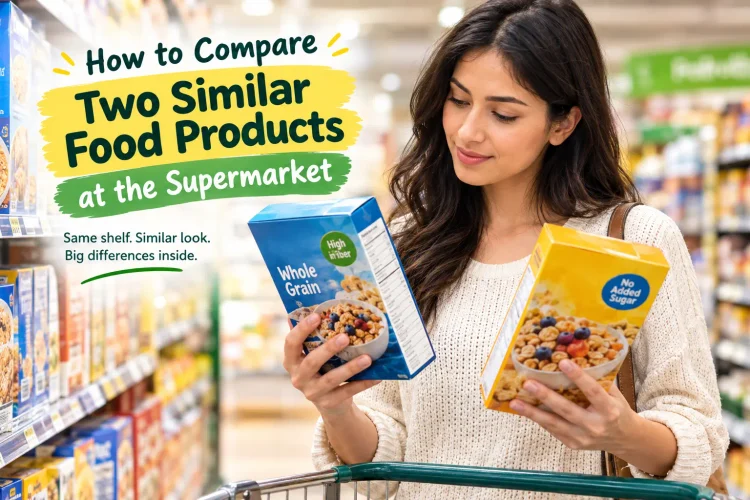

How to Read a Nutrition Label: 10 Things to Check Before You Buy

Have you ever stood in a supermarket looking at two similar products and wondered which one you should buy?
One cereal says “high in fiber.” Another says “high protein.” A yogurt says “no added sugar,” while a snack says “made with whole grains.”
They all sound good. But the front of the package doesn’t tell you the whole story.
The useful information is usually on the back.
You don’t need to be a nutrition expert to understand a food label. Just learn a few things to check before putting a product in your shopping cart.
Here are 10 simple things to look for when reading a nutrition label.
Important: Food-label formats and rules vary between countries. Always use the information and serving units shown on the package you are buying.
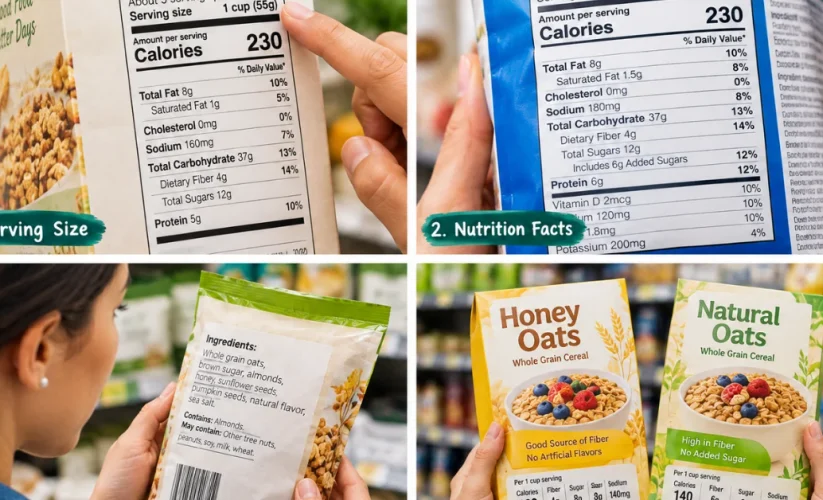
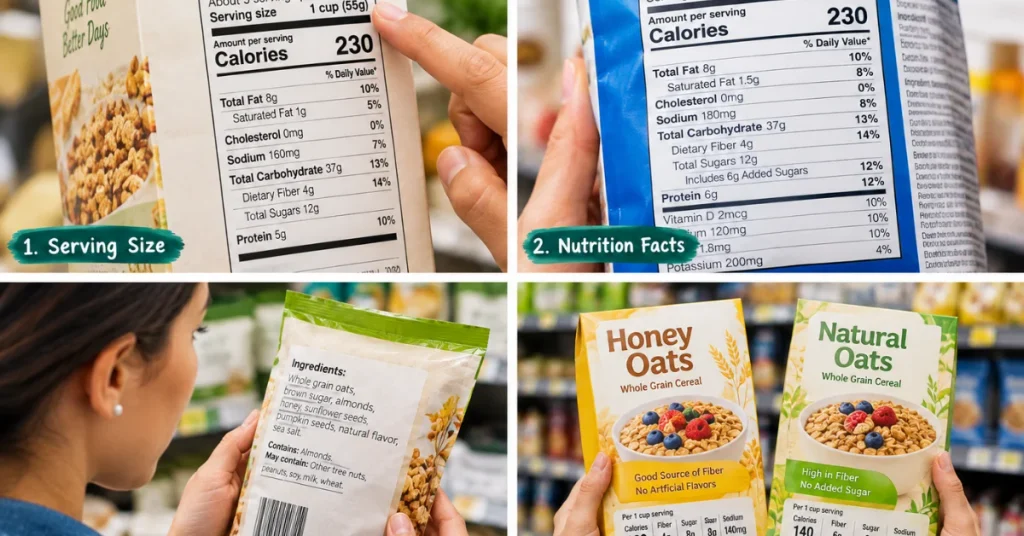
1. Start With the Serving Size
This is the first thing to check because all the numbers that follow may depend on it.
For example, imagine a snack packet has 2 servings and the label says:
- 150 calories per serving
- 6 g fat
- 10 g sugar
If you eat the whole packet, you’re getting twice those amounts.
So ask:
“How much does this label consider one serving?”
Then compare that with how much you actually plan to eat.
Remember, the serving size on a package isn’t necessarily the amount you should eat.
2. Check Calories — But Don’t Stop There
Calories tell you how much energy a food provides.
They’re useful when comparing similar products, but calories don’t tell you everything.
Two snacks could have around 200 calories each, but one might provide more protein and fiber while the other contains more added sugar or sodium.
So don’t just ask:
“How many calories?”
Also ask:
“What am I getting for those calories?”
3. Look at Protein
Protein is an important part of a balanced diet, and it can be useful to check when comparing foods like:
- yogurt
- breakfast cereals
- bread
- snack bars
- milk alternatives
- ready-to-eat meals
But don’t buy something simply because the front says “high protein.”
Turn the package around and check the actual protein amount.
Then look at the rest of the label too. A high-protein product can also contain a lot of added sugar, saturated fat or sodium.
Protein matters, but it’s not the only thing that matters.
4. Check Fiber
Fiber is another useful number, especially when you’re choosing cereals, bread, oats, pasta, crackers or snack bars.
If you’re trying to get more fiber in your diet, compare the fiber amounts of similar products.
But don’t stop there.
For example, a cereal can be high in fiber and still contain a lot of added sugar.
That’s why it’s better to look at the label as a whole.
5. Total Sugar vs Added Sugar
This is one of the parts of a food label that often causes confusion.
Total sugar can include sugar that naturally occurs in food.
Milk and fruit, for example, naturally contain sugar.
Added sugar is sugar added during processing or preparation.
This difference can be useful when comparing packaged foods.
Imagine two flavored yogurts with similar total sugar. One may have more naturally occurring sugar, while the other may contain more added sugar.
So when you’re comparing products, check added sugar when it is listed, and take a quick look at the ingredients too.
6. Check Sodium or Salt
Sodium and salt are related, but they’re not exactly the same thing.
It’s worth checking because some packaged foods can contribute a lot of sodium to your diet, particularly when eaten regularly.
Common examples include:
- instant noodles
- packaged soups
- sauces
- processed meats
- savory snacks
- ready-to-eat meals
When choosing between similar products, compare the sodium or salt amount.
If one has noticeably less, that’s useful information to consider.
7. Look at Saturated Fat
Fat isn’t automatically something you need to avoid.
Your body needs dietary fat, but different types of fat play different roles in the diet.
When comparing packaged foods, check the amount of saturated fat and trans fat, where this information is provided.
You don’t have to avoid every food that contains fat.
Instead, look at the type and amount and consider how the food fits into your overall diet.
8. Read the Ingredient List
The nutrition table tells you how much of certain nutrients are in the product.
The ingredient list tells you what the product is made from.
Ingredients are generally listed by weight, from the largest amount to the smallest, although labeling rules can vary by country and product.
This can be especially useful when comparing products that make claims such as “whole grain” or “natural.”
For example, if you’re buying bread marketed as whole grain, don’t just look at the front. Check the ingredients too.
The same idea applies to cereals, granola, protein bars, flavored yogurt, biscuits, sauces and packaged snacks.
9. Don’t Let the Front of the Package Decide
Food packaging is designed to get your attention.
You may see phrases such as:
- high protein
- low fat
- natural
- multigrain
- organic
- no added sugar
- made with whole grains
These claims may be useful, but they don’t tell you everything about the product.
A product can be low in fat but high in added sugar.
Another can be high in protein but also high in sodium.
So treat the front of the package as the introduction, not the whole story.
Turn it around and check the nutrition information and ingredients.
10. Compare Similar Products
This is one of the easiest ways to make better-informed choices.
Let’s say you’re choosing between two breakfast cereals.
Don’t decide based only on which box looks better.
Instead, compare the labels:
| What to Check | Product A | Product B |
|---|---|---|
| Serving size | — | — |
| Calories | — | — |
| Protein | — | — |
| Fiber | — | — |
| Total sugar | — | — |
| Added sugar | — | — |
| Saturated fat | — | — |
| Sodium/salt | — | — |
You don’t need one product to be lower in everything.
Think about what matters to you.
Want more fiber? Compare fiber.
Trying to reduce added sugar? Check added sugar.
Watching sodium? Compare sodium or salt.
The right choice can be different for different people.
A 30-Second Nutrition Label Check
Don’t have time to study every package?
Try this:
1. Serving size — How much does one serving represent?
2. Protein and fiber — Does it provide useful amounts?
3. Added sugar — How much does it contain?
4. Sodium or salt — How does it compare with similar products?
5. Saturated fat — Is there a similar option with less?
6. Ingredients — What are the main ingredients?
7. Compare — If you’re unsure, check another similar product.
That’s it.
You don’t need to memorize every number on the label.
What Does “Per 100 g” Mean?
Some packages show nutrition information per serving, while others may show it per 100 g or 100 ml.
This matters when you’re comparing products.
For example, if one cereal gives information per serving and another gives it per 100 g, you can’t compare the numbers directly.
Try to compare the same reference amount whenever possible.
What About Front-of-Pack Labels?
Some countries also use simplified nutrition information on the front of food packages.
For example, some products in the UK use traffic-light colors for fat, saturated fat, sugars and salt.
These can be helpful for a quick comparison, but don’t rely on them alone.
If you want more detail, check the nutrition panel and ingredient list on the back.
How Does This Work in India, the US and the UK?
The basic idea is the same wherever you shop:
Check the serving or reference amount → compare key nutrients → read the ingredients → compare similar products.
The exact label format can be different between countries.
For example:
- US packages commonly use a Nutrition Facts format.
- UK products may show nutrition information per 100 g or 100 ml and may also use front-of-pack traffic-light labeling.
- Indian packaged foods use nutrition information under applicable FSSAI labeling requirements.
So always use the information and units shown on the package you’re buying.
HealthyFoodKing’s Simple Rule
You don’t need to become a nutrition expert to shop smarter.
Just remember:
Don’t buy the front of the package. Read the back.
The front is designed to catch your attention.
The nutrition panel and ingredient list give you more information to work with.
Next time you’re standing in the supermarket, take a few seconds to turn the package around.
You might be surprised by what you find.
Frequently Asked Questions
What is the first thing I should check on a nutrition label?
Start with the serving size. It tells you what amount the nutrition numbers are based on.
Is a high-protein food automatically healthy?
No. Check protein along with fiber, added sugar, sodium, saturated fat and the ingredient list.
Is total sugar the same as added sugar?
No. Total sugar can include naturally occurring sugar, while added sugar is added during processing or preparation.
What should I check when buying breakfast cereal?
Compare serving size, protein, fiber, added sugar and sodium. Then look at the ingredients.
Is a short ingredient list always better?
No. The number of ingredients alone doesn’t tell you whether a product is nutritious. Look at what the ingredients actually are.
Should I avoid packaged food?
Not necessarily. Packaged foods can be convenient and can fit into a balanced diet. The important thing is understanding what you’re buying.
How should I compare two similar products?
Use the same reference amount when possible, then compare protein, fiber, added sugar, sodium or salt, saturated fat and ingredients.
Final Takeaway
Reading a nutrition label doesn’t have to be complicated.
Start with the serving size. Check calories, protein and fiber. Look at added sugar, sodium and saturated fat. Read the ingredients and compare similar products.
You don’t have to find a “perfect” product.
Just spend a few extra seconds looking past the front of the package.
Turn it around. Read the label. Then decide.