
How to Compare Two Similar Food Products at the Supermarket

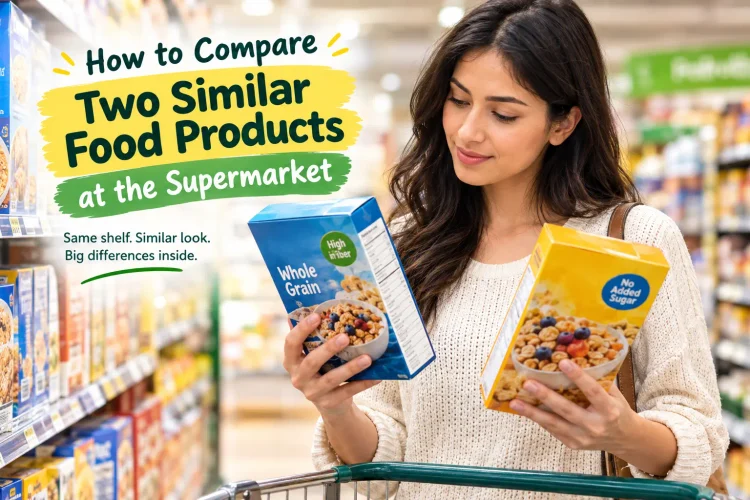
Have you ever stood in front of a supermarket shelf with two almost identical products in your hands?
Maybe you’re choosing between two breakfast cereals.
Both look healthy. Both have attractive packaging. One says “high in fiber.” The other says “no added sugar.” One is cheaper, while the other has a longer list of health claims on the front.
So which one should you buy?
This is where food labels can actually help.
You don’t need to spend 10 minutes studying every number on the package. You just need to know what to compare and in what order.
Here is a simple way to compare two similar food products before putting one in your shopping cart.
1. Make Sure You’re Comparing Similar Products
This sounds obvious, but it matters.
If you’re comparing two breakfast cereals, compare them with other breakfast cereals. If you’re choosing yogurt, compare similar types of yogurt.
Don’t compare a plain yogurt with a dessert-style yogurt and expect the numbers to tell the whole story.
Also check the basic product:
- Is it the same type of food?
- Are the serving sizes reasonably similar?
- Is one product flavored while the other is plain?
- Is one product designed for a different purpose?
Once you’re sure you’re comparing similar products, move to the label.
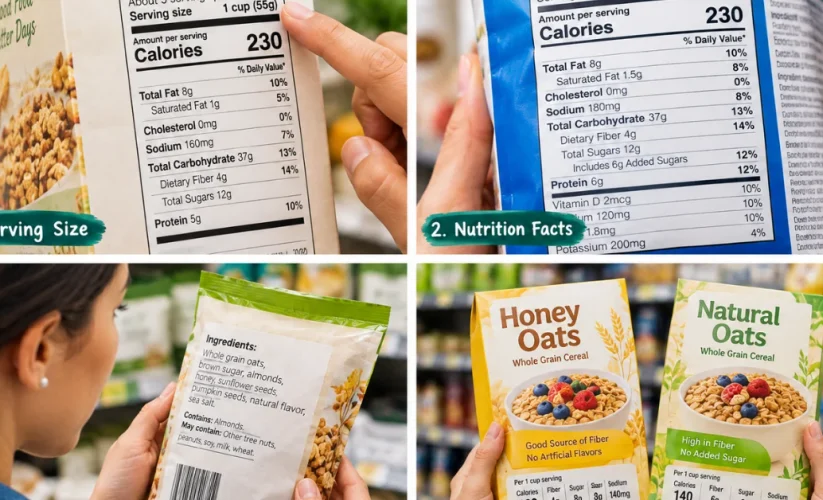
2. Check the Serving Size First
This is one of the easiest things to miss.
A product might appear to have fewer calories, less sugar or less sodium simply because the label uses a smaller serving size.
For example:
Product A
- Serving size: 30 g
- Calories: 120
Product B
- Serving size: 50 g
- Calories: 180
At first glance, Product A looks much lower in calories.
But you’re not comparing the same amount of food.
That’s why you should compare products using the same reference amount whenever possible, such as per 100 g or per 100 ml when that information is available.
This gives you a much fairer comparison.
Simple rule: Don’t compare numbers until you know what amount those numbers refer to.
3. Don’t Look Only at Calories
Calories are useful, but they are only one part of the picture.
Imagine two snack bars that both contain around 200 calories.
One might provide:
- more protein
- more fiber
- less added sugar
The other might contain:
- more added sugar
- very little fiber
- more saturated fat
So the calorie number alone doesn’t tell you which product fits your needs better.
Instead of asking only:
“Which one has fewer calories?”
also ask:
“What am I getting for those calories?”
That small change can make comparing foods much easier.
4. Compare Protein
Protein can be useful to check when comparing foods such as:
- breakfast cereals
- yogurt
- bread
- snack bars
- milk alternatives
- ready-to-eat meals
If you’re comparing two similar products and one has noticeably more protein, that may be useful information.
But don’t automatically assume more protein = better product.
A product can be high in protein and still contain a lot of added sugar, sodium or saturated fat.
So look at protein as one part of the comparison, not the final answer.
5. Check Fiber
Fiber is another number worth checking.
This is especially useful when comparing:
- breakfast cereals
- oats
- bread
- pasta
- crackers
- granola
- snack bars
If you’re trying to include more fiber in your diet, compare the fiber amounts between similar products.
For example, if two cereals are similar in price and calories, but one provides considerably more fiber, that’s useful information.
But again, check the rest of the label too.
A cereal can contain plenty of fiber while also containing a significant amount of added sugar.
The goal isn’t to find one “magic” number.
You’re looking at the whole product.
6. Look at Added Sugar
This is one of the areas where two similar products can be surprisingly different.
A product may contain naturally occurring sugars as well as sugars added during processing or preparation.
For example, plain milk naturally contains sugar. Fruit also naturally contains sugar.
That is different from sugar added to a flavored cereal, snack bar or dessert.
When comparing similar packaged foods, check the added sugar information when it is provided.
Then look at the ingredient list too.
If one product has less added sugar and otherwise fits what you’re looking for, that can be a useful reason to choose it.
7. Compare Sodium or Salt
Sodium is easy to overlook, especially when you’re more focused on calories, protein or sugar.
But some packaged foods can contain quite a lot of sodium.
This can happen with foods such as:
- instant noodles
- sauces
- soups
- savory snacks
- processed meats
- ready meals
- some packaged breads
When comparing two similar products, check the sodium or salt information shown on the package.
If one has noticeably less, that’s worth considering.
Just make sure you’re comparing the same serving or reference amount.
8. Check Saturated Fat
Fat isn’t automatically bad.
Your body needs dietary fat, and foods can contain different types of fat.
When you’re comparing similar packaged products, however, it can be useful to check the amount of saturated fat.
For example, imagine two similar snack products with similar calories.
One contains considerably more saturated fat than the other.
That’s another piece of information you can use when making your choice.
You don’t have to reject a food simply because it contains fat.
Look at the type and amount, then consider how the product fits into your overall diet.
9. Turn the Package Around and Read the Ingredients
This is where the front of the package can sometimes be misleading.
A product may say:
- high protein
- natural
- whole grain
- no added sugar
- made with real ingredients
- multigrain
Those statements can be useful, but they don’t tell you everything.
The ingredient list gives you another view of the product.
Ingredients are generally listed by weight, from the largest amount to the smallest, although exact labeling rules can vary between countries and products.
So if you’re comparing two cereals, for example, look at the ingredients of both.
You may find that one starts with whole grains while another starts with a more refined ingredient.
Or one product may contain several sources of added sugar.
You don’t need to understand every ingredient.
Just look for the things that matter to you.
10. Don’t Automatically Choose the Product With the Shortest Ingredient List
This is worth mentioning because it’s a common piece of advice that can be too simplistic.
A short ingredient list isn’t automatically healthier.
Some foods naturally need more ingredients.
For example, a simple packaged meal may contain several vegetables, grains, herbs, spices and other ingredients.
Instead of counting ingredients, ask:
What are the main ingredients, and does this product fit what I’m looking for?
That’s much more useful.
11. Look at the Price — But Don’t Let Price Make the Decision
Price matters.
If two products are very similar nutritionally, the cheaper one may make more sense for your budget.
But a higher price doesn’t automatically mean better nutrition.
You may be paying more because of:
- packaging
- branding
- marketing
- a specialty ingredient
- a particular production method
So compare the actual product rather than assuming the expensive option is better.
Sometimes the cheaper product is perfectly fine.
Sometimes the more expensive one may offer something you’re specifically looking for.
The label can help you decide.
12. Be Careful With Big Words on the Front
This is one of the easiest supermarket traps.
You see:
“HIGH PROTEIN”
or
“WHOLE GRAIN”
or
“NO ADDED SUGAR”
and your brain immediately thinks:
“That must be the better one.”
But stop for a second.
Turn the package around.
Check the serving size.
Look at the nutrition information.
Read the ingredients.
Then compare it with another similar product.
The front of the package is designed to catch your attention. The rest of the label gives you more information to work with.
A Simple Example: Comparing Two Breakfast Cereals
Let’s say you’re choosing between two cereals.
Both cost about the same and both look similar.
Instead of choosing based on the packaging, make a small comparison.
| What to Check | Cereal A | Cereal B |
|---|---|---|
| Serving size | Check | Check |
| Calories | Compare | Compare |
| Protein | Compare | Compare |
| Fiber | Compare | Compare |
| Added sugar | Compare | Compare |
| Saturated fat | Compare | Compare |
| Sodium/salt | Compare | Compare |
| Ingredients | Read | Read |
| Price | Check | Check |
You don’t need one cereal to win every category.
Maybe Cereal A has more fiber but Cereal B has less added sugar.
Maybe one costs less.
Maybe you simply prefer the taste of one.
The point is to understand what you’re buying instead of making the decision from the front of the box.
What If One Product Looks Better in Almost Every Category?
Then the decision becomes easier.
If two products are genuinely similar and one has:
- more fiber
- less added sugar
- less sodium
- similar calories
- similar protein
- a price you’re comfortable with
then you’ve got some useful information to work with.
But you still don’t need to call it the “perfect” product.
Food doesn’t have to be perfect to be part of a healthy diet.
What If the Numbers Are Very Different?
First, check the serving size.
This is important.
A big difference in calories or sugar may simply be because one product uses a different serving size.
If the labels provide information per 100 g or 100 ml, that can make the comparison easier.
Also check whether the products are actually the same type.
A flavored product and an unflavored version may naturally have different nutrition information.
Don’t rush to a conclusion before checking what you’re actually comparing.
A 30-Second Supermarket Comparison
If you’re standing in the supermarket and don’t want to spend ages reading labels, try this quick method:
1. Same product?
Make sure you’re comparing genuinely similar foods.
2. Same amount?
Check the serving size or compare per 100 g/100 ml when available.
3. Protein and fiber?
See how the two products compare.
4. Added sugar?
Check which product contains more.
5. Sodium or salt?
Compare the amounts.
6. Saturated fat?
Check whether there’s a noticeable difference.
7. Ingredients?
Take a quick look at what the products are made from.
8. Price?
Consider whether the difference is worth paying for.
That’s enough for most everyday supermarket decisions.
You don’t need to become a food-label expert.
Don’t Try to Find a Winner in Every Category
This is probably the most important thing to remember.
Food isn’t a school exam where one product has to get the highest score.
You might care most about fiber.
Someone else might be trying to reduce added sugar.
Another person may be watching sodium.
Someone else may simply need a product that fits their budget.
So instead of asking:
“Which product is healthiest?”
try asking:
“Which product fits what I’m looking for?”
That is a much more useful question.
What About Organic, Natural or Other Claims?
If one product says “organic” and another doesn’t, don’t assume that automatically settles the comparison.
The same applies to words such as:
- natural
- premium
- traditional
- wholesome
- multigrain
- high protein
- light
These claims can tell you something about the product, but they don’t replace the nutrition panel and ingredient list.
Use them as extra information, not as the whole decision.
You Don’t Have to Compare Everything
There will be days when you’re tired, hungry and just want to finish your shopping.
That’s normal.
You don’t have to stand in every aisle reading two labels from top to bottom.
Save the detailed comparison for foods you buy regularly or products where you’re genuinely unsure.
For everyday shopping, even checking serving size, added sugar, fiber, protein, sodium and ingredients can give you a much better picture.
HealthyFoodKing’s Simple Rule
When two products look almost the same, don’t let the packaging make the decision for you.
Turn the package around.
Check the serving size.
Compare the nutrition information.
Read the ingredients.
Look at the price.
Then choose the product that fits your needs.
You don’t need to find the most expensive product, the product with the most health claims, or a product that looks perfect on paper.
You just need enough information to make a choice you’re comfortable with.
The next time you’re standing in front of a supermarket shelf with two similar products in your hands, take an extra 30 seconds.
Read. Compare. Then choose.
Frequently Asked Questions
Is the product with fewer calories always better?
No. Calories are only one part of the nutrition picture. Compare them alongside protein, fiber, added sugar, sodium, saturated fat and the ingredients.
Should I always choose the product with more protein?
Not necessarily. Protein can be useful, but a high-protein product may also contain a lot of added sugar, sodium or saturated fat.
Is a shorter ingredient list always healthier?
No. The number of ingredients isn’t enough to judge a product. Look at what the ingredients actually are and how the product fits your needs.
Why should I compare products per 100 g or 100 ml?
Because serving sizes can be different. Comparing the same reference amount makes it easier to see how two similar products actually differ.
Should I always buy the cheaper product?
Not necessarily. Price is one factor. If two products are similar, the cheaper option may make sense, but you should also consider the nutrition information, ingredients and what matters to you.
What should I check first when comparing two foods?
Start with the serving size. Then compare the nutrition information and ingredients. This prevents you from making a decision based on numbers that aren’t directly comparable.
Do I need to read every number on the nutrition label?
No. For everyday shopping, focus on the information most relevant to you, such as protein, fiber, added sugar, sodium or salt, saturated fat and calories.
Final Takeaway
Comparing food products doesn’t have to be complicated.
When two products look similar, don’t just look at the front of the package.
Check the serving size, compare the nutrition information, read the ingredients, consider the price, and think about what actually matters to you.
You might only need 30 seconds to spot a useful difference.
And sometimes, you’ll discover that both products are perfectly reasonable choices.
That’s okay too.
The goal isn’t to make every shopping trip perfect.
It’s simply to make a more informed choice with the information already sitting on the package.